Travelling exhibition
The Matura as a Magic Wand
The Matura, magic and a wand – what do they have in common?
The Matura is a maturity test that first set foot on Slovenian soil 175 years ago.
The Wand is a symbol of the authoritarian school of the past.
Magic evokes a sense of overwhelming beauty and mystery.
The exhibition highlights 30 years of the reintroduction of the Matura exam in Slovenia – from its beginnings, challenges and dilemmas to its development and successes that have shaped its meaning and role in the education system. The exhibition was conceived by Mag Marjetka Balkovec Debevec and Mateja Ribarič, curators of the Slovenian School Museum.
Exhibition Catalogue
EXHIBITION CONTENT
The exhibition The Matura as a Magic Wand: 30 Years of the Reintroduction of the Matura Exam in Slovenia symbolically reflects key developmental milestones in thirty thematic strands. The Matura has undergone various changes, from 1850, when the first grammar school graduates took the maturity test, to the abolition of the Matura in the mid-1980s in the era of career-oriented education. The modern Matura was reintroduced in independent Slovenia in 1995. In the exhibition, the story opens up an innovative reflection on the Matura as a test of maturity, drawing parallels with broader social developments, touching on the specific situation of the COVID epidemic and presenting the innovations of both the general and vocational Matura in the new era of digitalisation and technological progress. To the tune of the eternal hymn Gaudeamus, the exhibition takes us back to a time of stress, a time of prom jokes and quadrilles. Since the matura is a special trial and test for every graduating student, reading the reflections takes us back to our own experience of the Matura. The exhibition concludes with statistics, a chronology from 1850 onwards and a look into the future.
SPATIAL CONCEPT AND DESIGN OF THE TRAVELLING EXHIBITION
The conceptual design of the travelling exhibition suggests a world that has moved from the analogue to the digital age. With luminous surfaces that change with the light in the room, encased in light but solid aluminium benches, it invites you to explore the content – like a learning process, like a step towards understanding. Like opening a book, like lifting the curtain from ignorance to understanding, and understanding is the basis for integration into society. The crumpled surfaces speak of the effort of learning – the repetitions, the doubts, the sleepless nights. The exhibition is temporary, a moment that passes, but its memory remains.
The exhibition’s signature – the logo is based on a tight, bold linear typography that conveys determination, precision and academic authority. Its strong verticals symbolise overcoming obstacles along the way and deepening knowledge. The circle, as a symbol of perfection, marks the completed cycle of learning and the decades of the Matura. The successive growth of the three circles – three decades – in the sign emphasises the expansion of knowledge and the progress of the Matura system, while the series of three circles like dots at the end of the text indicates the continuation of the path after the Matura.




Exhibition authors
The Matura as a Magic Wand: 30 Years of the Reintroduction of the Matura Exam in Slovenia
A temporary travelling exhibition of the Slovenian School Museum
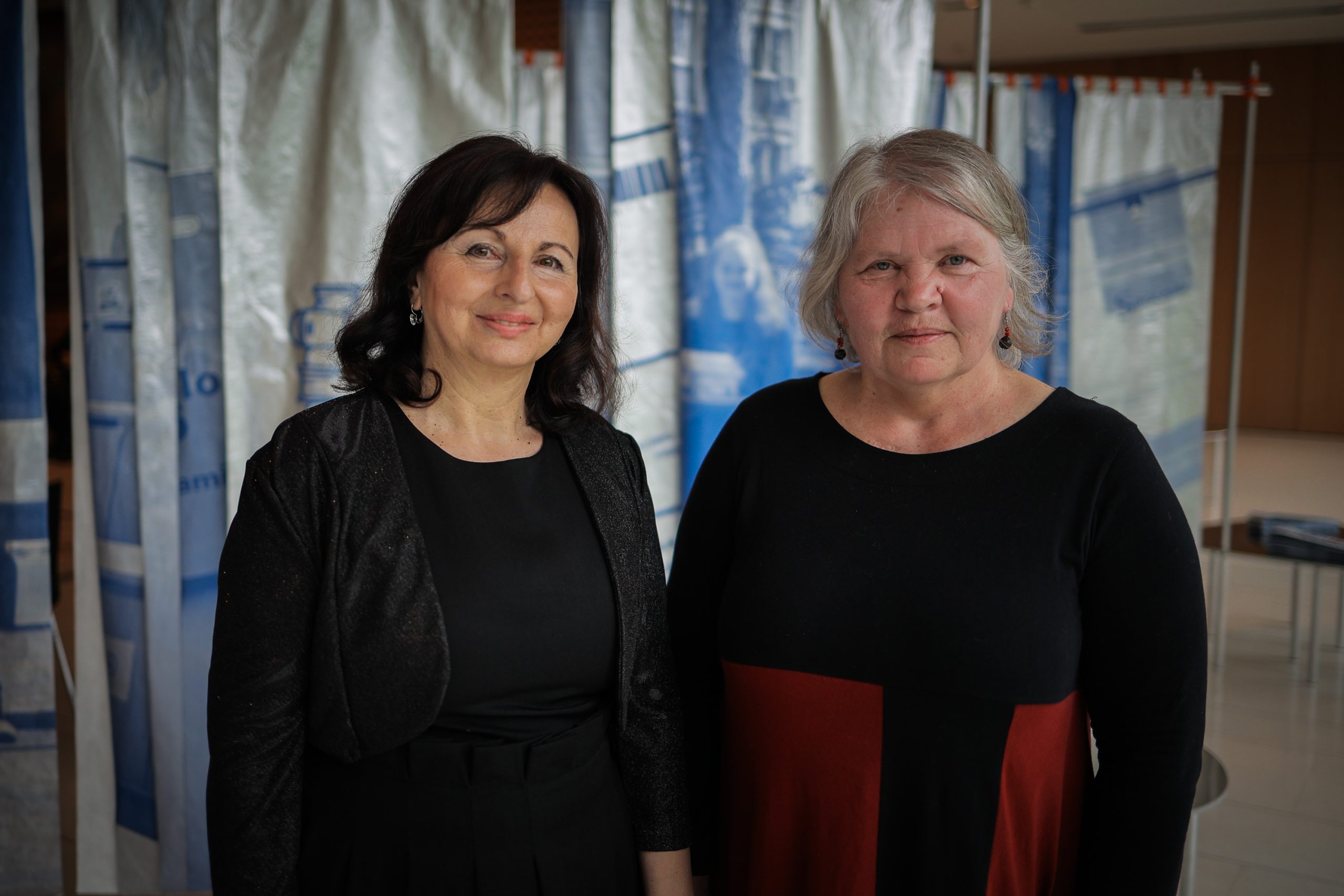
Authors of the exhibition: Mag Marjetka Balkovec Debevec and Mateja Ribarič, Slovenian School Museum
Architecture of the exhibition: Jure Hrovat, Ana Kreč, Julia Koželj, svet vmes, d. o. o.
Graphic design of the exhibition: Irena Gubanc
Proofreading: Martina Oberman Žnidarčič
Promotion and coordination of the exhibition tour: Andreja Cigale, Slovenian School Museum
Collaborators of the exhibition: Ksenija Guzej, Gregor Gartner, Matic Intihar, Slovenian School Museum
Collaborators in the preparation of the exhibition: Polona Papler in Marija Prelovšek, National Examinations Centre
Exhibition organised by: Slovenski šolski muzej, represented by Mag Stane Okoliš and National Examinations Centre, represented by Dr Darko Zupanc
The exhibition was made possible by the Slovenian Ministry of Education.