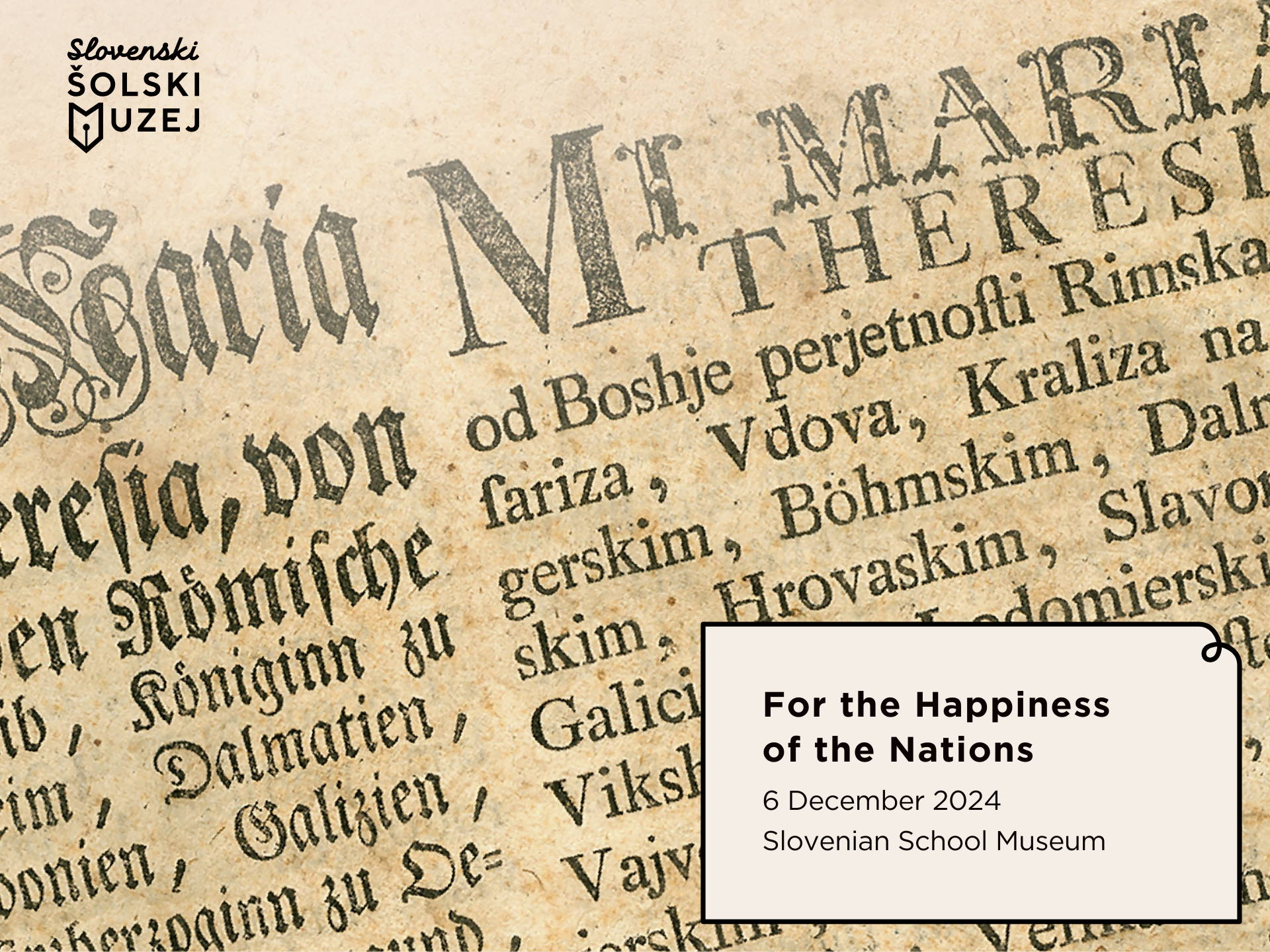
For the Happiness of the Nations”: closing event to celebrate the 250th anniversary of Maria Theresa’s General School Ordinance
6 December 2024 at 12:00 noon
Slovenian School Museum
Plečnikov trg 1, Ljubljana
The year 2024 marks a quarter of a millennium since the publication of the “General School Ordinance for all German primary schools in all imperial and royal hereditary lands” (Allgemeine Schulordnung für die deutschen Normal-, Haupt- und Trivialschulen in sämmtlichen Kaiserl. Königl. Erbländer). Published in 1774, it was the first state law on primary education to apply in most of the territory of present-day Slovenia. In accordance with its scope and purpose, it can be defined in modern language as a school code.
The authorities, led by Maria Theresa (reign: 1740-1780) and her son Joseph II (reign: 1780-1790), began to establish a centrally managed state education system in the Austrian part of the Habsburg Empire. It officially included all social classes and children of both sexes from the age of six to twelve, and marked the beginning of the process of making education compulsory and widely accessible. The creation of the school code was significantly influenced by Enlightenment thought, which emphasised the role of human reason and the expansion of education to increase the efficiency and wealth of the state (in the fields of agriculture, the military, taxation, etc.). The Ordinance influenced the printing of school textbooks and other books in regional or vernacular languages, thus contributing to the development of expressive capacities and greater public recognition of the Slovenian language.
Despite its imperfect implementation, the School Ordinance of 1774 brought about profound and lasting changes in the field of education in Central Europe. Above all, it established a public space in which the state became permanently present among all levels of the population. It also helped to consolidate certain principles that are still valid today in social life: education as a state concern, the awareness of the need for all children to have access to the core body of knowledge, the importance of group teaching, and the consideration of the moral formation of pupils.
PROGRAMME
|